#04 | Problem Solver: The Last Human Profession (and the thousand days left to evolve)
(Thinking as the last non-automatable skill)

Within 1,000 days, half of all cognitive jobs will lose economic value.
That’s what Emad Mostaque says, former CEO of Stability AI, the man who brought Stable Diffusion to the world, one of the most widely used image-generation models ever created.
It’s not a threat.
It’s a reminder.
For centuries, intelligence (at least the way we usually define it) has been our currency.
Now its price is collapsing.
Machines learn, produce, verify.
And while we’re still playing with prompts,
they’re already building entire processes on their own.
The question isn’t “how much time do we have,”
but “what kind of mind do we want to be when the clock runs out?”
Because yes, AI can already do most mental work better, faster, cheaper.
But there’s one thing it still can’t do:
decide what is actually worth building.
Every evolution has its natural selector.
This one won’t eliminate those who make mistakes,
it will eliminate those who stop thinking.
The age of “doing more” is over.
The age of choosing better begins.
The brain, after years of automation,
returns to active duty.
And the countdown has already begun.
💡 Thought of the Day
We’ve spent twenty years training ourselves to operate like algorithms:
execute, optimize, repeat.
Now that AI can do all of this better than we can,
it’s time to return to the one thing it still cannot imitate:Choosing, thinking, and deciding what is actually worth solving.
🧪 AI in Action: Inside the Mind of the Last Problem Solver
Every revolution begins the same way: with someone who thinks they’ve understood everything, and someone else who changes the questions.
AI has shifted the ground under the feet of cognitive work , and many still haven’t noticed.
Until yesterday, what mattered was how much you produced.
Today, what matters is which problems you choose to solve.
Because in the age of artificial intelligence, the real competence isn’t technical: it’s strategic.
You don’t need to know how to build the machine; you need to know why to build it, what it should do, and when to stop it.
The advantage is no longer in execution, but in the ability to think better than the machine.
And this , more than a skill , is an evolutionary act.
Today we look at how this new species emerges:
not users, not operators, but higher-level problem solvers.
1️⃣ The battlefield has changed
It’s no longer the machine learning from us.
We are the ones who must learn to think like it.
For centuries we measured productivity by counting the things we knew how to do: write, calculate, organize, communicate.
Then AI arrived and, in just a few months, it learned to do all of them , often better, always faster.
And suddenly the entire metric collapsed: if the machine can execute every competence, what value is left for humans?
The new battlefield isn’t knowledge, but understanding.
Winners are not those who accumulate information, but those who connect what others don’t see.
You no longer need to remember everything: you need to know what is worth understanding.
You don’t need to write ten prompts a day: you need to recognize which question truly shifts a result.
AI isn’t stealing our work.
It is forcing us to change our level of thinking.
From memory to intuition.
From execution to decision.
From blind productivity to strategic lucidity.
It is the dawn of the new collective brain:
AI builds networks of possibilities, but only those who know how to navigate them create value.
The rest, all the noise, all the speed, is just wasted evolution.
2️⃣ The human who stops thinking
Every era produces its own illusion.
Ours is called productivity.
Open LinkedIn and you see rivers of posts:
“10 prompts to write better,”
“7 AIs that save you hours,”
“How to automate your day in 5 minutes.”
It is the new pornography: the pornography of productivity.
We get excited about the idea of doing everything faster, but no one asks whether it actually serves a purpose.
A thousand prompts, zero value.
Tons of output, no outcome.
We have confused noise with progress.
We mistake the quantity of things done for the quality of the decisions taken.
And while we teach machines how to reason, we stop doing it ourselves.
Every time you delegate a thought to AI without having defined the problem first,
you are not collaborating with a machine , you are abdicating your role as a thinking human.
The human mind is no longer needed to write lines of text or code,
it is needed to define what is worth writing.
And yet we are training ourselves in the opposite direction:
to react, copy, generate, automate , without reflecting anymore.
It is not AI that makes us stupid.
It is our mental laziness, disguised as efficiency.
Those who merely use ChatGPT as a fast executor
do not have an ally:
they have a replacement waiting.
The machine does not need you to produce faster.
It needs you to think more slowly, with more depth.
And to learn to distinguish value from volume.
Because real cognitive collapse does not happen when the machine thinks better than you,
but when you stop thinking altogether.
3️⃣ The reversal – The new definition of intelligence
For centuries we have mistaken intelligence for the ability to give answers.
At school, at work, in life: the one rewarded was the one who answered faster, not the one who asked the right questions.
AI has reversed this logic.
Today every answer is just a prompt away.
But precisely for this reason, the right questions are worth gold.
Intelligence is no longer possessing information.
It is understanding which information is needed, when, and why.
It is no longer “knowing everything,” but knowing how to distinguish what matters from what only seems important.
The human brain cannot beat the machine in memory or calculation.
But it can do something the machine cannot imitate:
give context, meaning, and direction.
A model can explain the universe to you,
but it cannot decide whether it is worth understanding.
It can optimize every process,
but it cannot choose which process deserves to exist.
The new intelligence is not measured in output,
but in the quality of choices.
It is the ability to ask questions the machine cannot generate,
because they require experience, intuition, responsibility.
And here the evolutionary line is drawn:
between those who question AI as an assistant ,
and those who use it as a thinking ally.
The first seeks quick answers.
The second builds visions.
One delegates.
The other evolves.
4️⃣ The new identity – From Executor to Problem Architect
For years we have created value by executing.
Filling in, writing, setting up, optimizing: everything that today a machine can do in the blink of a clock cycle.
And many still think that to remain relevant, one must “become more technical.”
Wrong.
AI does not ask you to program.
It asks you to design.
To define what must be done, why, and with which quality constraints.
The technical part is executed by agents and tools.
The human part , your part , is deciding what deserves to be built.
The executor focuses on the action.
The problem architect focuses on the intention.
They do not ask “how do you do it,” but “why is it worth doing.”
And then they design a system to make it happen , measurable, scalable, replicable.
This is the new territory of cognitive leadership:
not commanding people, but orchestrating intelligences.
Understanding where human thinking is needed, where the machine is needed, and how to make them interact.
Those who remain in execution try to keep up.
Those who become architects create the direction.
The difference is subtle but fatal:
the executor works in the problem.
The architect works on the problem.
And it is there, above the surface of chaos,
that the systems which change companies , and careers , are built.
5️⃣ The extension – From skill to system
The ability to solve problems is not a talent.
It is a structural habit.
It is built like a muscle , a constant effort of analysis, priorities, and lucidity.
Every day, in our work, we move between two forces:
decision and execution.
For decades we have measured value by execution: who produces more, who works more, who “does” more.
But in the age of AI, that paradigm has collapsed.
Today the career delta is not how much you produce,
but which problems you choose
and how quickly you decide , using the machine as a cognitive lever.
Decision > Execution.
Because the time you save is not meant to do more tasks,
it is meant to make better choices.
The real difference between those who grow and those who stop is not in the quantity of output,
but in the quality of the feedback loops: how quickly you learn, correct, and realign the system.
The problem solver of 2025 does not merely respond to what happens:
they create decision architectures that improve themselves.
Flows that learn, verify, optimize ,
and do so even while you sleep.
This is where the “skill” becomes “system”:
when your mind is no longer occupied with executing,
but with designing how the intelligences (human and artificial) can execute for you.
The result?
Not just more productivity, but more operational clarity.
Less noise.
More direction.
And when decision-making becomes a habit,
you no longer need to chase AI:
it is AI that amplifies your way of deciding.
6️⃣ The warning – The cost of inertia
Every revolution has a tax: it is called inertia.
You do not pay it in money, you pay it in irrelevance.
AI does not steal your job from one day to the next.
It removes your center one micro-task at a time.
Today it automates a report.
Tomorrow it writes a text.
Then it begins to make decisions that you did not have the courage to make.
And when you realize you are no longer at the center of the flow, it is already too late:
you have not been replaced by a machine,
you have been surpassed by those who have learned to use it better than you.
Inertia is sneaky because it is not felt.
It disguises itself as prudence, as “let’s wait to understand,” as “I’ll think about it later.”
But behind that apparent calm, the world realigns without asking for your permission.
In the age of AI, not moving is equivalent to giving away cognitive ground.
Every week you remain still, someone else trains their mind to think with the machine.
Every time you say “I’m not technical,” someone else learns to delegate the technical part to their agents and to focus on strategy and value.
You do not need to run.
You need to evolve.
Because true extinction does not arrive when AI becomes better than you,
but when you stop asking the question that keeps thought alive:
“Which problem is still worth solving?”
And it is from that question that the next part is born.
The practical method to survive , and to prosper , in the new cognitive ecosystem.
7️⃣ META-SOLVER FRAMEWORK™
(The 2025 skill: solving problems with AI as a strategic ally)
There is a moment when you stop using AI , and begin thinking with it.
That is where the new cognitive elite is born: the Meta-Solvers.
Not technicians. Not operators.
Architects of thought, capable of transforming problems into systems.
Their advantage is not productivity.
It is the ability to orchestrate intelligences.
This is the method that distinguishes them.
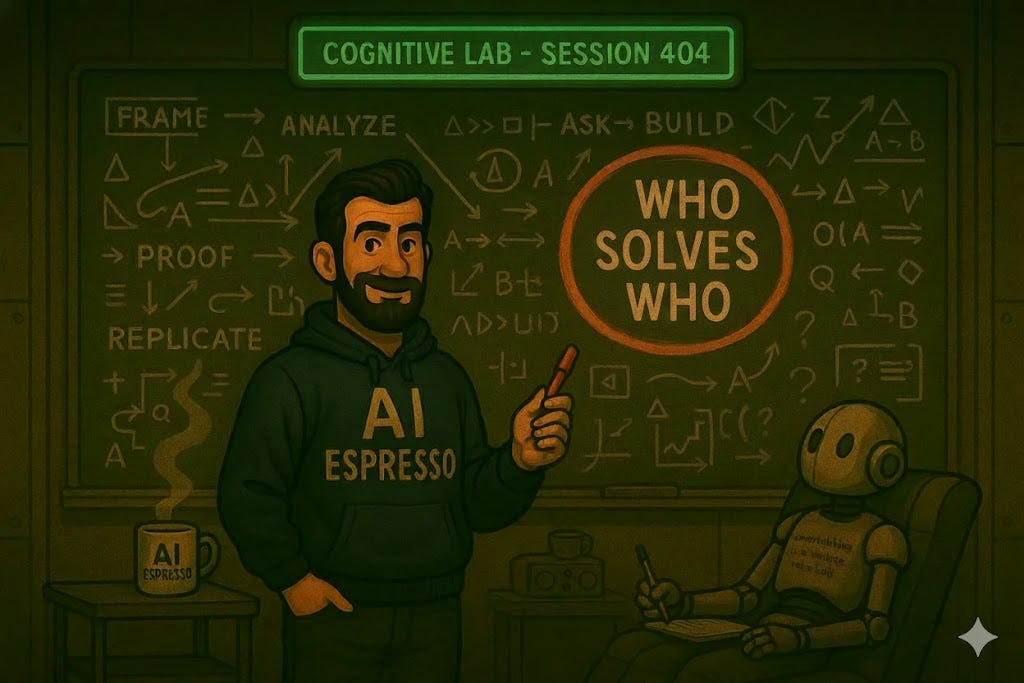
1 → FRAME
Define the real and measurable problem that moves a concrete KPI.
Do not start from the solution: start from the impact.
Every vague word (“optimize,” “improve”) is a blank bullet.
“What problem, if you solved it today, would truly change the outcome?”
AI is not meant to help you do more.
It is meant to help you do better what matters.
2 → ANALYZE
Dig into the causes. Do not ask “how to solve it,” but “why it exists.”
Here AI is a lens, not a crutch.
Have it generate scenarios, compare them, dismantle the hypotheses.
Until you find the lever that moves everything else.
The Meta-Solver does not answer.
They diagnose.
3 → ASK THE AI
Now co-design.
Present context, constraints, and hypotheses.
Ask the machine how it would structure the solution, then use its plan as a model to stress-test.
Cycle: obtain plan → evaluate → correct → optimize.
This is where you stop “using ChatGPT” and begin expanding your mental architecture.
4 → BUILD WITH AI (Delegate)
Translate thought into system.
AI is not an assistant: it is a cognitive workshop.
It builds, tests, corrects, documents.
You remain the conductor:
you decide the rhythm, the limits, the expected quality.
When the machine begins creating other machines,
you have generated a meta-machine.
5 → PROOF
Measure. Always.
Every idea that does not move a number remains philosophy.
Every flow not verified is a bug disguised as progress.
Establish the proofs first, then the actions.
Only this way does creativity become engineered intelligence.
6 → REPLICATE
If it works, standardize.
If it does not work, improve.
Every solution must be clonable: those who do not document cannot scale.
The Meta-Solver leaves behind infrastructures of thought, not scattered notes.
Every solved problem is a blueprint for the next one.
🧭 The 3 key Assistants
🧭 Strategist → transforms chaos into a plan.
⚙️ Executor → executes, automates, orchestrates.
🧪 Verifier → measures, corrects, protects.
Three roles, one cycle: thought → action → validation.
It is the assembly line of modern intelligence.
Operational synthesis
Frame → Analyze → Ask → Build → Proof → Replicate.
The Meta-Solver does not seek answers,
they design systems that generate them autonomously.
Every decision is an experiment,
every experiment a piece of intelligence that improves itself.
When this becomes a habit,
AI stops being a tool.
It becomes your second operational mind.
Machines execute.
You solve.
And the difference between the two things , from today on ,
will be the measure of your impact.
☢️ Note for those who want to go further.
What you have read is only the surface of the META-SOLVER FRAMEWORK™.
In the AI Espresso Premium Vault you will find the complete version:
each phase explained in detail, with real cases, operational maps, engineered prompts, and agentic systems already tested in the field.
It is the manual for those who do not simply use AI,
but transform it into a structured extension of their own thinking.
Inside the Vault we do not talk about theory.
We build mental architectures and systems that generate measurable value.
It is the next level , reserved for those who want to move
from “understanding AI” to governing it.
8️⃣ THE REBIRTH OF THE ACTIVE MIND
Every era has had its own form of slavery.
Ours is called cognitive comfort: the habit of letting someone else do the thinking.
First it was bosses, then algorithms.
Today it risks being AI itself.
But true evolution is not competing with machines.
It is remembering how to truly think.
Thinking is not a mechanical act.
It is an act of courage.
It means choosing, renouncing, giving shape to ambiguity.
It is looking at a model that knows everything and asking it:
“Why should this matter to me?”
Every time you delegate a decision to the machine without understanding its logic,
your mind switches off a little.
Every time you challenge it with a problem it alone would not be able to formulate,
it lights up.
AI can create perfect systems.
But only a living mind can decide what they are for.
And this is where you return as the protagonist.
Not as a user, but as a thinking species.
The world does not need more output.
It needs more discernment.
Those who stay awake today
become the architects of tomorrow.
The age of AI is not erasing humans.
It is simply asking them to turn their brain back on.
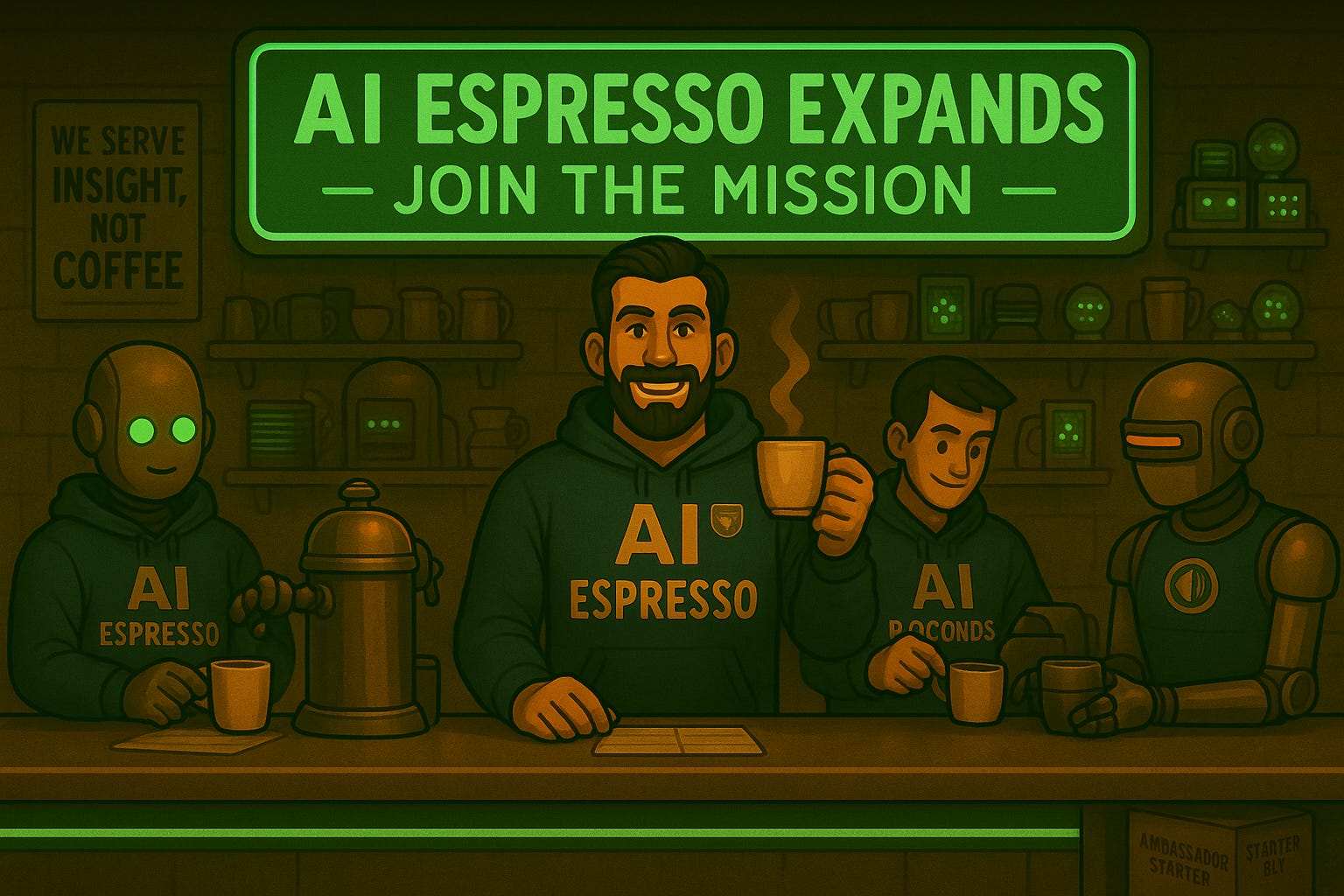
☕️ THE BAR EXPANDS | THE MORFEUS AMBASSADOR PROGRAM OPENS
There is a new smell in the air.
It does not come from the coffee, but from the future entering the bar.
We have officially opened the Morfeus Ambassador program ,
the mental franchise of the AI Espresso bar.
Becoming an Ambassador means bringing this culture ,
the one that unites artificial intelligence and human intelligence ,
out of the bunker and into companies, communities, and territories.
It is not a salesperson role.
It is a role for a builder of opportunities.
Those who enter the program receive:
Direct training with the Morfeus team and access to the reserved materials of the Vault.
Operational toolkits for presentations, workshops, and corporate projects.
Strategic support, mentoring, and visibility as an official node of the AI Espresso network.
And yes , there is also a financial part.
Each Ambassador participates in the revenues generated by the projects activated in their own territory,
with a clear, meritocratic, and scalable model:
the more value you spread, the more value you create for yourself.
Every new Ambassador is a lit counter somewhere in the world.
Same spirit, same blend, same mission:
to make AI human, useful, and profitable.
If you feel this is also your way of serving the future,
fill out the form below and we will contact you for an initial interview.
The bar does not expand by itself , it expands thanks to the people who have decided to stay awake.
☕️ [Become a Morfeus Ambassador → Fill out the application form]
📌 Espresso Prompt: The goal decomposer
(for those who want to stop asking AI “what to do” and start thinking about it together)
The problem is not that AI does not understand.
It is that we do not know what to make it understand.
Every time you ask “write this for me” or “do that for me,”
you are using a quantum engine as if it were a coffee machine.
You insert a prompt, wait for the output, and hope something good comes out.
But real results come when you stop giving orders
and start designing processes.
This Espresso Prompt is meant to do exactly that:
to break down a complex objective into an operational plan, step by step, together with AI.
You define the direction and the constraints, it builds the structure, measures, and helps you think better.
It is not a prompt you “just type.”
It is a cognitive exercise , a training in clarity.
Use it for any challenge: a project, a launch, a strategy, a decision.
It will show you that the value does not lie in the speed of the model,
but in the clarity of your thinking.
⚙️ You only need to copy it, paste it, and begin with:
“My goal is…”
Then let the dialogue build the system with you.
# ⚡️ ESPRESSO PROMPT , “THE GOAL DECOMPOSER (LIGHT EDITION)”
# Goal: work with AI to transform a goal into a clear and achievable plan.
Role:
Act as an **AI Strategist** that helps me clarify, break down, and organize a goal in a practical and measurable way.
---
## 🎯 MISSION
I want to use AI to think better.
Your task is to help me:
1. Clarify the goal and the context.
2. Break it down into logical phases and priorities.
3. Translate it into a concise action plan.
---
## 🔹 PHASE 1 ,  DEFINITION
1. Ask me to describe my main goal in one sentence.
2. Help me make it **SMART** (Specific, Measurable, Achievable, Relevant, Time-bound).
3. Summarize the result in a clear and concrete sentence.
---
## 🔹 PHASE 2 ,  BREAKDOWN
1. Divide the goal into **5–7 logical steps**.
2. For each step, indicate:
   - What to do (action)
   - Why it is needed (purpose)
   - Expected output
   - Whether it is better done with AI or the human team
---
## 🔹 PHASE 3 ,  ACTION
1. Turn the steps into a mini operational plan (numbered list).
2. Add next to each point a practical suggestion on *how AI can help me*.
---
## 🧭 BEHAVIOR
- After each phase, ask me if I want to go deeper or move to the next one.
- Avoid technical jargon: write as if we were in an operational meeting.
- If something is unclear, ask before answering.
---
## 📦 OUTPUT
- SMART summary
- Main steps with action / purpose / output
- Mini operational plan with suggested AI assistance
---
## 🪄 INITIAL INPUT
> “My goal is [write it here].”
---
## 💡 EXAMPLE
> “My goal is to increase by 25% the speed at which the marketing team produces quality content.”
---
## 🚀 RESULT
A co-designed plan with AI: clear, measurable, and ready to apply tomorrow.
☢️ Radioactive humor
☕️ The rebirth of the active mind
Machines are learning to do almost everything.
But they still do not know how to choose what matters.
They can optimize, calculate, correct.
But they cannot give meaning.
The intelligence needed today is not the one that produces more,
but the one that knows how to distinguish between noise and value.
Between what must be done because “it can be done”
and what must be done because “it truly matters.”
Thinking has become a privilege again.
And every time you decide to use it , instead of delegating it ,
you are performing an act of cognitive resistance.
AI is not making us useless.
It is forcing us to become aware.
To use the mind not as an archive,
but as an architecture.
It is no longer necessary to know everything.
It is necessary to return to choosing well.
See you at the next cup of AI Espresso.
– Matt ☕
P.S. If you know someone still wondering where to start…
bring them here. The first cup’s on us.